
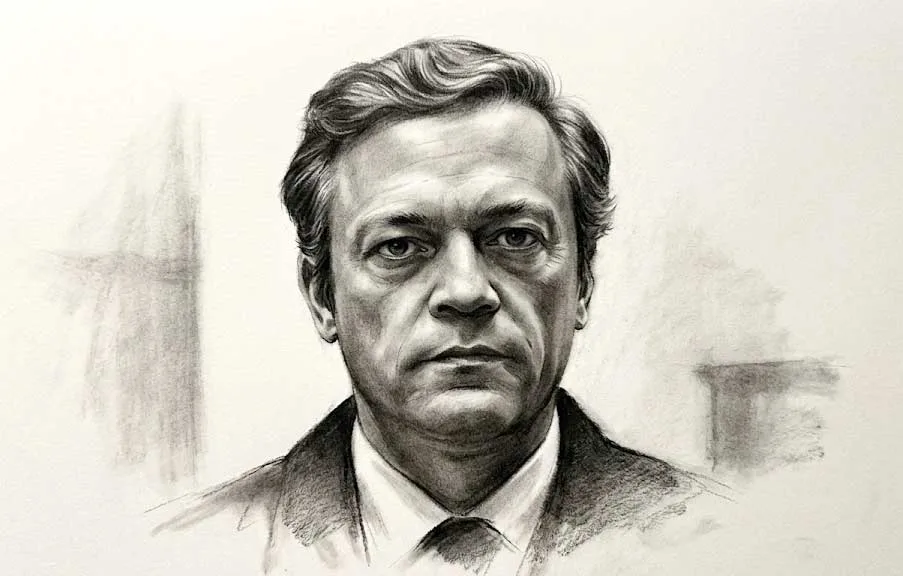
What I regret is the instrumentalization and judicial and legal-partisan politicization driven by party-political intentions.
Pedro Calado, Rotas da Autonomia
Pedro Calado was once seen as the natural successor to Miguel Albuquerque. Albuquerque is president of the Regional Government of Madeira and leader of the regional PSD. In January 2024, a corruption investigation that led to his detention seemed to end that path.
Now the former mayor of Funchal says he wants to return to politics. He does not rule out leading the party, but he will not run against Albuquerque. Calado is the guest of 'Rostos da Autonomia' (Faces of Autonomy), a podcast by the newspaper DIÁRIO with the support of the Legislative Assembly of Madeira. It was released on 1 November 2026 on dnoticias.pt and TSF-Madeira.
Born in Lisbon in 1971, Calado Spent His First Years in Mozambique
Calado was born in Lisbon in October 1971 and has a twin brother, Vítor. When he was three months old, the family moved to Mozambique. His mother worked at the military mess there, and his father, a Madeiran, was a medical sales representative.
His mother is Angolan. In early 1974, sensing that political change was coming, his parents left for Angola. They then returned to Madeira shortly before the revolution of 25 April 1974. Other relatives were less fortunate.
With the revolution, many Portuguese lost what they had. That is exactly what happened to my uncles and maternal grandparents. They came with only the clothes they were wearing.
From Lisbon to Madeira in 1998, Then Five Years in Banking
Calado lived in Madeira until 1989. He then moved to the mainland in the first year of Portugal's general university entrance exam. He studied management in Santarém and finished his degree at NOVA University Lisbon in 1994.
"Times were not easy and, with two children studying on the mainland, we went through some difficulties. I had a grant, and that is why I felt the need to work while I studied," he said.
After graduating, he joined the audit firm KPMG in Lisbon. He was later asked to open the firm's office in Madeira and returned to the island in 1998. He went on to spend five years in banking and worked with companies on financial matters.
Albuquerque Brought Him Into Funchal City Council in 2005
Calado was a PSD sympathiser and had joined the party's youth wing, but he had no political career. That changed in 2005, when Albuquerque, then mayor of Funchal, invited him to join a new list for the city council.
He served the full 2005-2009 term and was re-elected with the PSD's absolute majority for the next one. Those years saw a split in the PSD between Albuquerque and Alberto João Jardim, the long-time head of the regional government. In 2012, Albuquerque lost a leadership vote by a few dozen votes, with Calado at his side. After the PSD's heavy losses in the 2013 local elections, Albuquerque won the party in 2014 and the regional election in 2015.
In the interview, Calado said the PSD had not planned properly for a successor in the Jardim years. In his view, this led to internal division and the loss of key municipalities in 2013. Parties, he argued, should plan leadership changes the way large companies do.
Vice-President of the Regional Government From 2017, Mayor of Funchal in 2021
Calado did not join the regional government in 2015. He entered halfway through the term, in 2017, as vice-president. His task was to organise the executive. According to DIÁRIO, that work may have helped the PSD win the 2019 regional election against the Socialist Party (PS) of Paulo Cafôfo, who was seen as the favourite.
In 2021, he led the PSD list for Funchal City Council and won back the region's largest municipality, which the PS had run since 2013.
Detained on 24 January 2024 and Held for About Three Weeks
On 24 January 2024, while still mayor, Calado was detained in a extensive police investigation into suspected corruption. He was held in Lisbon for about three weeks before a judge released him with the mildest measure available, a statement of identity and residence. He resigned as mayor while in custody.
In the podcast, Calado says he stayed calm because he knew nothing illegal had happened. He does not criticise the Public Prosecutor's Office for looking into complaints. He does criticise the way the operation was carried out, which he describes as a media show/staging. He says he would have handed over documents from the first day if he had simply been asked.
He also says he might not have resigned had he known how the case would develop. He made that decision, he explains, to protect the council from constant media pressure.
Nearly Three Years Later, Calado Claims the Complaints Were Political
According to DIÁRIO, almost three years later the case has not advanced. Calado says the investigation had only political aims ("Este processo foi com intenções partidárias?" - "Não tenho dúvida nenhuma" ) and that none of the suspicions have any basis. In his view, the complaints came from political opponents who wanted to weaken the region.
The case was followed by a period of political instability. Albuquerque resigned as head of the regional government on 26 January 2024, and Madeira held snap regional elections in May 2024 and March 2025. Calado argues that voters kept backing the PSD because they trusted the people who built the region's autonomy.
Juidicial Politicization?
What I feel regret over is an instrumentalization and a judicial and legal-partisan politicization driven by partisan motives.
The Core Tension in Calado's Argument
This claim creates a delicate balance in his public defense:
He cannot deny the prosecutor's right to investigate: He explicitly admits that prosecutors must review complaints when submitted.
He claims the system was exploited: He argues that political actors learned they could "weaponize" complaints, knowing the judicial machinery would execute high-drama raids that destroy political careers regardless of the eventual trial verdict.
By calling it partidarização judicial Calado is essentially summarizing his belief that the legal system allowed itself to be used as a political weapon.
Excess of Democracy? Calado Proposes a 5% Threshold to Keep Small Parties Out of Parliament
While his own party is running the region ever since Madeira gained independence, Calado is critical of small parties polling at 1-3%. He accuses them of using minor issues and court injunctions. In his view, they block projects approved by large majorities. He warns that an excess of democracy has turned into a lack of restraint, where individuals and small movements can attack institutions without being held to account.
I fear that with the emergence of more parties, the proliferation of an excess of democracy leads to negative results.
His answer is an electoral threshold. Parties that fail to reach 5% of the vote, as in Germany, should not have seats in legislative assemblies, he said. He also argued that four-year municipal terms are too short to complete major projects.
Calado Rules Out a Leadership Bid While Albuquerque, PSD Leader Since 2014, Stays
Calado says his whole political career has been built alongside Albuquerque. As long as Albuquerque leads the PSD, he will not run for the leadership and will stay by his side. He recalled that in 2015, when he disagreed with the make-up of the government, he chose to step back quietly instead of going public.
His family has urged him to stay away from politics. But Calado says he still has a passion for public service and is available to help shape Madeira's future when and where it makes sense.
Source: dnoticias.pt



Comments