
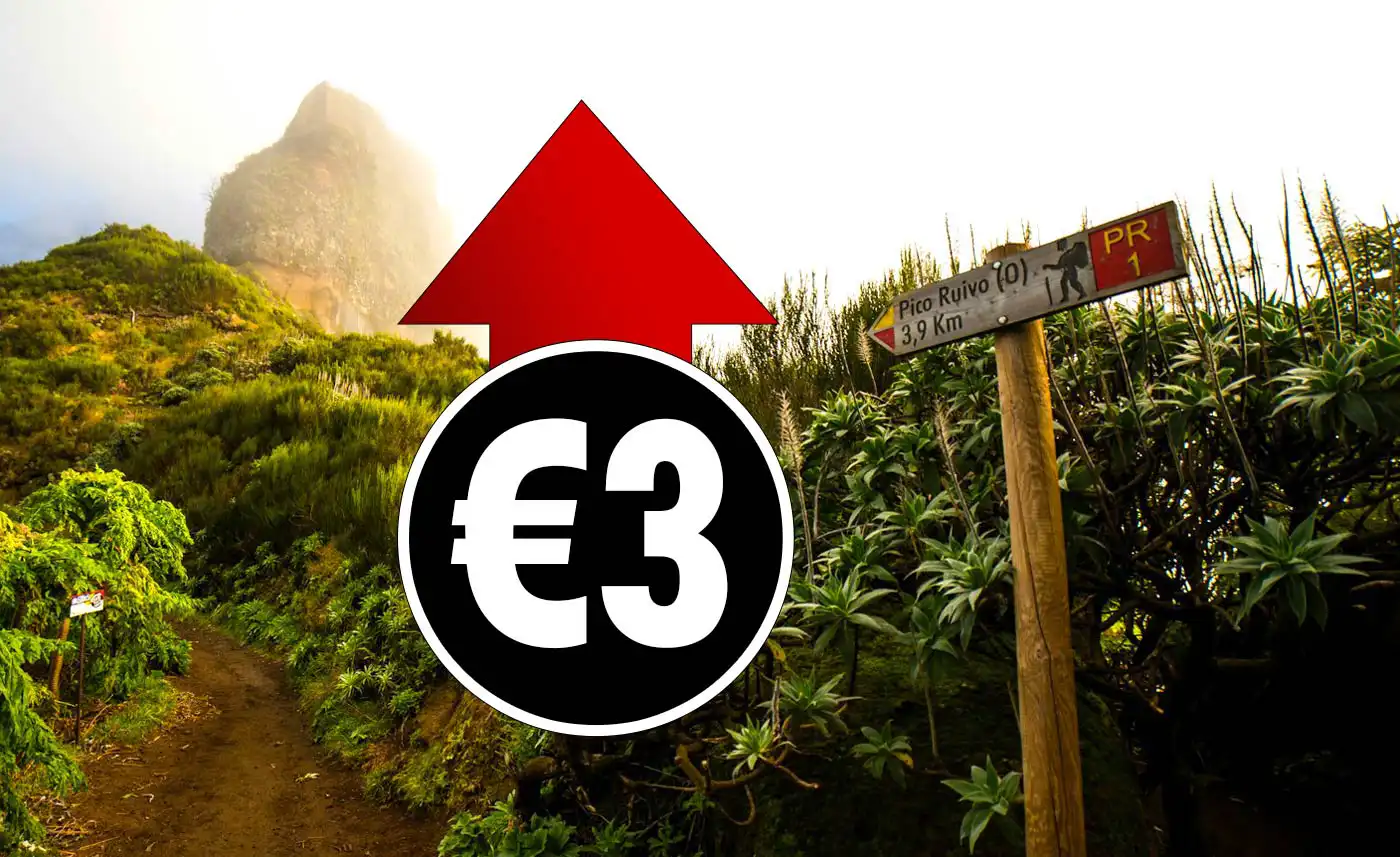
Madeira’s 42 Recommended Trails to Require Prior Registration from January 1
Starting January 1, all 42 officially recognized hiking trails in Madeira will require prior registration and payment, except for residents registered on the Simplifica portal. Slots will be released every 30 minutes throughout the day to avoid overcrowding. The Pico do Arieiro – Pico Ruivo trail (PR1), reopening in April, will be the most expensive among them, according to Eduardo Jesus, Regional Secretary for Economy, Tourism, and Culture.
From January 1, all [trails] will be paid, except for residents registered on the Simplifica portal.
This is the first time it has been explicitly mentioned that residents do need to register on the Simplifica web portal. It indicates that it will not be sufficient to simply show a resident car at the trail.
The exact new pricing for the hiking trails and the pricing for parking has not yet been determined but is said to be announced shortly.
The government is currently focused on capacity management and the Simplifica system. Next year, it will invest in improving the park logic. Currently, teams are being reinforced to meet new challenges. In the initial phase, those arriving at trails without a reservation will encounter a staff member and a terminal to pay; if slots are available for that hour, they may proceed. A transition period is acknowledged, as this represents “a significant change.”
In addition to entry control, there will be inspections along the trails and fines for non-compliance.
Study by University of Madeira Shows No Daily Overcrowding on Trails
The maximum daily visitor load for each trail is based on research by the Observatório de Turismo da Universidade da Madeira. Eduardo Jesus stated that none of the trails are considered to be overcrowded on a daily basis:
Calculated the load, we compared it with the presence of people in the physical space, and we reached a first conclusion: none of the trails we manage are overcrowded. In other words, no trail exceeds its defined capacity on any given day.
The new system will distribute visitors throughout the day to prevent peak-hour congestion.
Six Special Parks Will Be Created in Madeira’s Most Popular Areas
The government will create six individualized parks or management zones with specific rules and controls at:
Pico do Arieiro
Ribeiro Frio
Queimadas
Ponta de São Lourenço
Fanal
Rabaçal.
Each park will have its own management, entry control, and parking. Visitors will be able to check availability and book through Simplifica, the mobile web portal, and the Institute for Forests and Nature Conservation website, the latter still being updated.
Parking Will Be Relocated to Reduce Traffic Near Trails
To reduce vehicle congestion, associated parking will be moved to more distant areas with connecting transport options under consideration. The government is also reinforcing staff to manage these changes and ensure smooth operations during the transition period, described by Eduardo Jesus as “a significant change.”
Operators Transporting More Visitors Will Receive Priority Access
Groups traveling in larger vehicles may receive priority access to reduce the number of cars on trails.
It’s not the excess of people, it’s the excess of cars that has complicated mobility
This system aims to reduce traffic while accommodating organized group travel.
Trail Capacity Set Using 15 Correction Factors, Example Shows 1,322 Daily Visitors
Carrying capacity depends on trail characteristics, weather, maintenance, and visitor time. For example, Vereda do Arieiro can host 1,322 visitors per day, with 171 simultaneously, adjusted with a correction factor of 1. These factors are reviewed every three months to maintain safe and sustainable use.
Government Plans Continuous Monitoring and Research Until 2026
Since 2017, the Observatório de Turismo da Universidade da Madeira has studied trail impact and sustainability, including projects in Laurissilva forest and capacity diagnostics.
In 2025, four research lines were created: capacity, product, monitoring, and alert/safety. The team will continue pilot projects to monitor visitor flow, assess physical aptitude, and profile tourists throughout the next year.
Source: Diário de Notícias Madeira

Comments