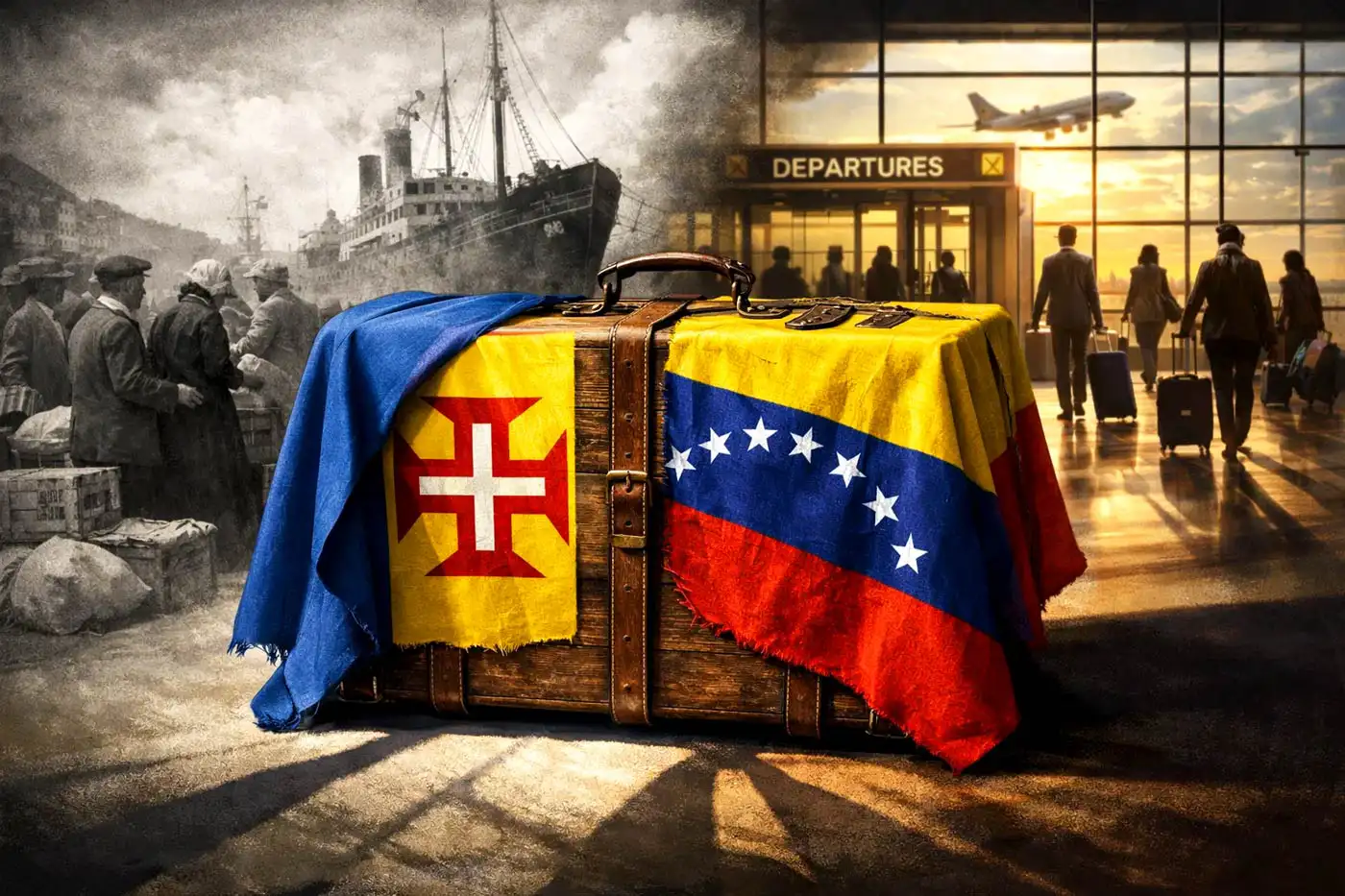
The relationship between Madeira and Venezuela is one of the most unusual demographic loops in modern history. For over a century, these two distant points - a small Portuguese archipelago and a sprawling South American nation - have functioned as a single economic and social ecosystem. What began as a move from a poor island toward a land of "black gold" has turned into a massive reverse migration that is changing Madeira today.
With the estimated number of Portuguese descendants in Venezuela reaching 500,000 at its peak, the collapse of the Venezuelan state has caused a homecoming of historic proportions. Today, local data shows that Venezuelan citizens are the primary group of foreign residents in Madeira. They bring a Caribbean culture that is now a permanent part of the island’s daily life.
Early 20th Century Migrants Found Specialized Work in Curaçao Oil Refineries
The bond between these regions was built before the mainland oil boom began. In the early 1900s, Madeiran laborers left the island to work in the Dutch Antilles. They found jobs in the massive refineries of Curaçao and Aruba. These facilities were built to process Venezuelan crude oil and these workers became a specialized industrial force.
When Venezuela began building its own oil infrastructure, these experienced Madeirans were among the first to move to the mainland. This created a path for the thousands of people who would follow them in the decades after.
Venezuela Created an Open-Door Immigration Policy for Europeans in the 1940s
By the late 1940s, Venezuela was one of the wealthiest nations in the world. The government started an immigration policy to attract Europeans. They wanted hardworking families to modernize the country’s farming and shop sectors. For Madeirans living under the stagnation of the Estado Novo dictatorship, this was an excellent invitation. This period saw many men leave the island. Many married "by proxy" - they sent a letter and a ring back to Madeira so their brides could join them in a country they had never visited.
Luso-Venezuelans Built 300,000-Person Communities
In Venezuela, the Madeiran community became very successful in the food and retail industries. They managed the majority of the "panaderías" (bakery-cafés) and "abastos" (grocery stores) across the country.
At the peak of the oil boom in the 1950s-70s, Venezuela became the primary destination for Madeirans. Official government data from the 1970s and 80s often cited that roughly 70% to 80% of all Portuguese in Venezuela were of Madeiran origin. By the 1970s, estimates say that around 300,000 people in Venezuela were from Madeira. This was more than the entire population of the Madeira itself. These people were not just migrants, they were the middle class of Venezuela.
The 1983 Black Friday Currency Crash Ended Decades of Easy Economic Growth
Venezuela's wealth was based on oil, and in 1983, that base broke. On 18 February 1983, a day known as Black Friday ("Viernes Negro"), the Venezuelan currency lost its value. The Black Friday didn't happen because of a single mistake, it was a "perfect storm" of bad timing, heavy debt, and a sudden drop in oil prices.
For the Madeiran community, who had treated the Venezuelan Bolívar as a "gold standard," it was the day the dream started to crumble. This event ended a long period of wealth. For the first time, the money sent back to Madeira began to stop. While many people stayed and hoped for things to improve, 1983 was the first time that returning to Madeira became a common conversation in the social clubs of Caracas.
Madeira’s 1976 Political Autonomy Created a Modern Region Ready for Returnees
While Venezuela began to struggle, Madeira was changing. After the 1974 Carnation Revolution in Portugal, Madeira gained political autonomy in 1976. This allowed the island to manage its own development. Later, the island used European Union funds to build modern tunnels, hospitals, and schools. This change was very important.
The European Union turned Madeira from a place of poverty into a modern region with economic opportunities . When the crisis in Venezuela became worse, this autonomy meant the island was ready to welcome its people back with good infrastructure.
Hugo Chavez Started Nationalizing Private Businesses After Taking Power in 1999
Throughout the years between 1983 and 1998 Venezuelan underwent an economic depression that led to the election of Hugo Chavez in 1999. Soon, the situation for many business owners became even more dramatic, as his government started a policy of seizing private property.
Chavez’ economic philosophy called "Socialism of the 21st Century" viewed private retailers as the enemy in a "class war." It targeted the bakeries and supermarkets that Madeirans had built over many years.
The state began taking private businesses without warning. And after a general strike in 2002-2003, Chávez famously fired over 18,000 employees (nearly half the workforce) on live television with a whistle. These weren't just office workers; they were the geologists, engineers, and technicians who knew how to operate the complex oil fields.
The first group of people to return to Madeira in the early 2000s were those who saw the looming danger. They managed to save some of their money before the government made it impossible to move wealth out of the country.
Nicolas Maduro Caused a 50% Drop in National Oil Production
Under the government of Nicolas Maduro, the decline became a total collapse. The politicization of the state oil company led to a 50% drop in production since 2013. Without oil money, the state could not provide food or medicine. For the Luso-Venezuelan community, this was a disaster. Thousands of families fled to Madeira with only their Portuguese passports. Because they have dual nationality, they are national citizens. This allows them to use the healthcare and schools that their ancestors helped pay for through years of sending money home.
The Capture of Maduro by US Forces Sets Things in Motion, But Uncertainty Reigns
The geopolitical landscape has the potential to change with the capture (or hijacking) of Nicolas Maduro by US forces under President Trump’s orders. For much of the diaspora, the capture of the man they blame for the destruction of their second home feels like justice. However, it brings a new set of questions. The future of Venezuela appears more uncertain than ever, as Trump hinted that neither Nobel Peace Prize winner Marina Machado nor the latest election winner, Edmundo González, would be given a path to power. But then again, Trump is known to change his mind.
Local Records Show 15.5% of Madeira’s Foreign Residents are Venezuelan
Data from the Regional Directorate of Statistics of Madeira (DREM) shows how Madeira is changing. Venezuelan citizens are now the main group of foreigners on the island. They represent 15.5% of the foreign population.
While some older people want to return if the political and economic situation improves, many younger people with little to no ties to Venezuela, understandably prefer the safety of a country in the European Union. They have found a quiet life where daily life runs smoothly and basic needs are easy to meet. As of today, things in Venezuela could turn for the better, but the old elite is still in charge and the US administration needs to prove it stands on the side of freedom in Venezuela.

Comments