
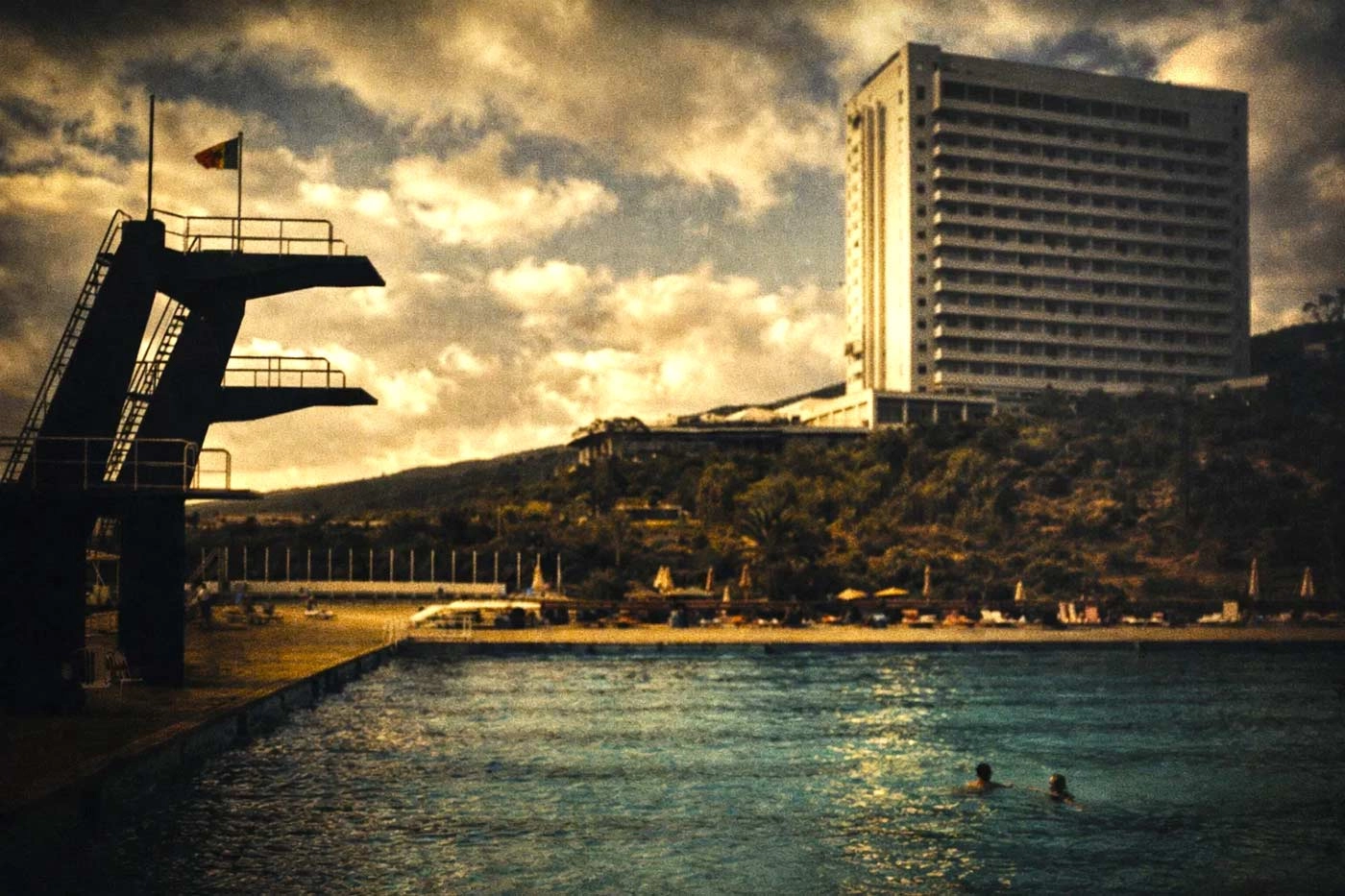
Hotel Atlantis Opened in 1972 as Part of an Ambitious National Tourism Plan
Hotel Atlantis opened in 1972 in Água de Pena, near Madeira Airport, during a period when Portugal was actively promoting tourism as a driver of economic growth. The project was planned in the late 1960s, at a time when Madeira’s visitor economy was still small and uneven across the year. Atlantis was conceived as a large, modern hotel that could signal confidence in the island’s future and attract international guests beyond the traditional centres of Funchal.
▶️ Location of Hotel Atlantis (1972 - 2000)
The Project Was Large and Modern Compared With Madeira’s Tourism at the Time
When it opened, Atlantis stood out for its scale and design. It was a modernist building with hundreds of rooms, conference areas, restaurants, pools and gardens. For Madeira in the early 1970s, this size was very unusual. Tourism arrivals were growing, but not yet at a level that could reliably fill a hotel of this capacity throughout the year. Seasonal demand remained strong, while winter occupancy was limited.
Airport Proximity Was Seen as an Advantage During the Jet Travel Era
The decision to build next to Madeira Airport was intentional and aligned with international thinking at the time. In the late 1960s, the airport was small, newly opened and close to the coastline.
Planners expected the surrounding land to develop into a new tourism gateway, where visitors would arrive by plane and move directly to nearby hotels. This approach matched the logic used in other destinations during the early jet age.
Cheap and Available Land Made Large-Scale Construction Possible
Compared with Funchal, land near the airport was cheaper, less built-up and easier to assemble into a single plot. This made it suitable for a hotel of Atlantis’ size, which required space for gardens, pools and parking. In the city, such a project would have required extensive demolition and higher costs. At the planning stage, the airport area appeared to offer fewer constraints.
The Matur complex represented an innovation in the context of island hotels, moving away from Funchal and establishing itself a few dozen kilometers from the city.
Piscina Olimpica da Matur: Flagship Recreation Facility
The Hotel Atlantis was also the flagship accommodation for the “Matur Tourist City" or “Madur Tourist Complx“. There, an Olympic pool was built as the hotel's primary recreational facility. Because the hotel was so large (a 5-star unit with over 200 rooms), it needed high-end infrastructure to attract international guests.
The pool, with its Olympic dimensions and diving boards, was its "star" attraction. At the time, it was the only Olympic-sized pool (50m) in the region. It hosted major national championships and was a premier training ground for athletes.
Early Perception Mixed Local Pride With Tourist Curiosity
Among many locals, the hotel was first seen as a symbol of progress and a sign that Madeira could compete with larger tourist destinations. It created jobs and brought international visitors to a less-developed area of the island. Tourists often described it as modern and calm, away from the city centre. At the same time, its distance from Funchal made it feel isolated for guests who wanted urban life and nightlife.
Ownership Remained Local Despite International Branding
The hotel was developed by Grupo Grão-Pará, linked to Portuguese business interests, and initially operated under the Holiday Inn brand. This partnership gave Atlantis international visibility, but ownership remained local. Available records do not show major ownership changes during its lifetime. Management and branding evolved, but the underlying financial responsibility stayed with the same group.
Financial Pressure Appeared Early and Worsened Over Time
Although Atlantis attracted attention when it opened, it struggled to achieve stable profitability. Madeira lacked the year-round demand needed to sustain such a large hotel. International flight connections were limited compared with later decades, and package tourism was still developing. By the late 1980s and early 1990s, operating costs rose while income remained uneven, leading to significant losses.
Structural Problems Increased Costs Near the Coastline
The hotel’s location close to the sea created long-term technical problems. Built on reclaimed or coastal land, the structure suffered from salt corrosion, humidity damage and material wear. The relentless atlantic environment was a major concern. Maintenance costs increased steadily, and experts warned that proper renovation would require heavy investment. These issues reduced the economic case for keeping the building open.
Tourism Preferences Shifted Away From Large Modernist Hotels
By the late 1980s, tourism tastes had changed. Visitors increasingly preferred smaller, higher-quality hotels with updated layouts and more personalised services. New properties opened in Funchal and other parts of the island, offering better access to urban life and modern facilities. Atlantis began to feel outdated and inefficient compared with these newer alternatives.
Airport Expansion Turned a Strategic Location Into a Liability
A decisive factor was the expansion of Madeira Airport. Runway extensions over the sea increased aircraft size, frequency and safety zones. The height and proximity of Hotel Atlantis became incompatible with aviation requirements. Noise and vibration also reduced its appeal as a holiday destination. What once seemed a strategic advantage became a major limitation.
Closure in 1994 Ended a 22-Year Experiment
The hotel ceased operations at the end of January 1995, effectively closing in 1994 after 22 years. Financial losses, high maintenance costs and the airport expansion all played a role. Around 230 employees were affected. The closure reflected broader limits of 1960s and 1970s tourism planning, where speed and scale often took priority over long-term resilience.
After standing empty for several years, Hotel Atlantis was demolished by controlled implosion in March 2000. Renovation was considered too costly given the building’s condition and location. Clearing the site was also necessary for airport safety and future planning. From an economic point of view, removal was seen as more realistic than reuse.
The Site Remains a Reminder of Unrealised Development Plans
Since the demolition, various redevelopment ideas have been proposed for the area, including leisure and commercial projects. Many remained on paper, as construction was hardly realizable due to a series of restrictions and regulations related to airport activities and civil aviation safety. The space today stands as a reminder of an earlier vision for Madeira’s tourism geography that never fully materialised.
A Short Life That Was Typical of Its Era
In retrospect, Atlantis was not an exception. Many large hotels built during the 1960s and 1970s tourism boom lasted only two or three decades. They were constructed quickly, with optimism about growth that did not always match reality. While during its glory days in the 1970s and 80s, it was a prestigious 5-star establishment known for high-end service. But eventually, Hotel Atlantis fits this pattern: ambitious, symbolic and ultimately overtaken by economic, technical and planning limits. A colossus of its time, it was soon outpaced by the evolving demands and realities of modern tourism.


Comments