
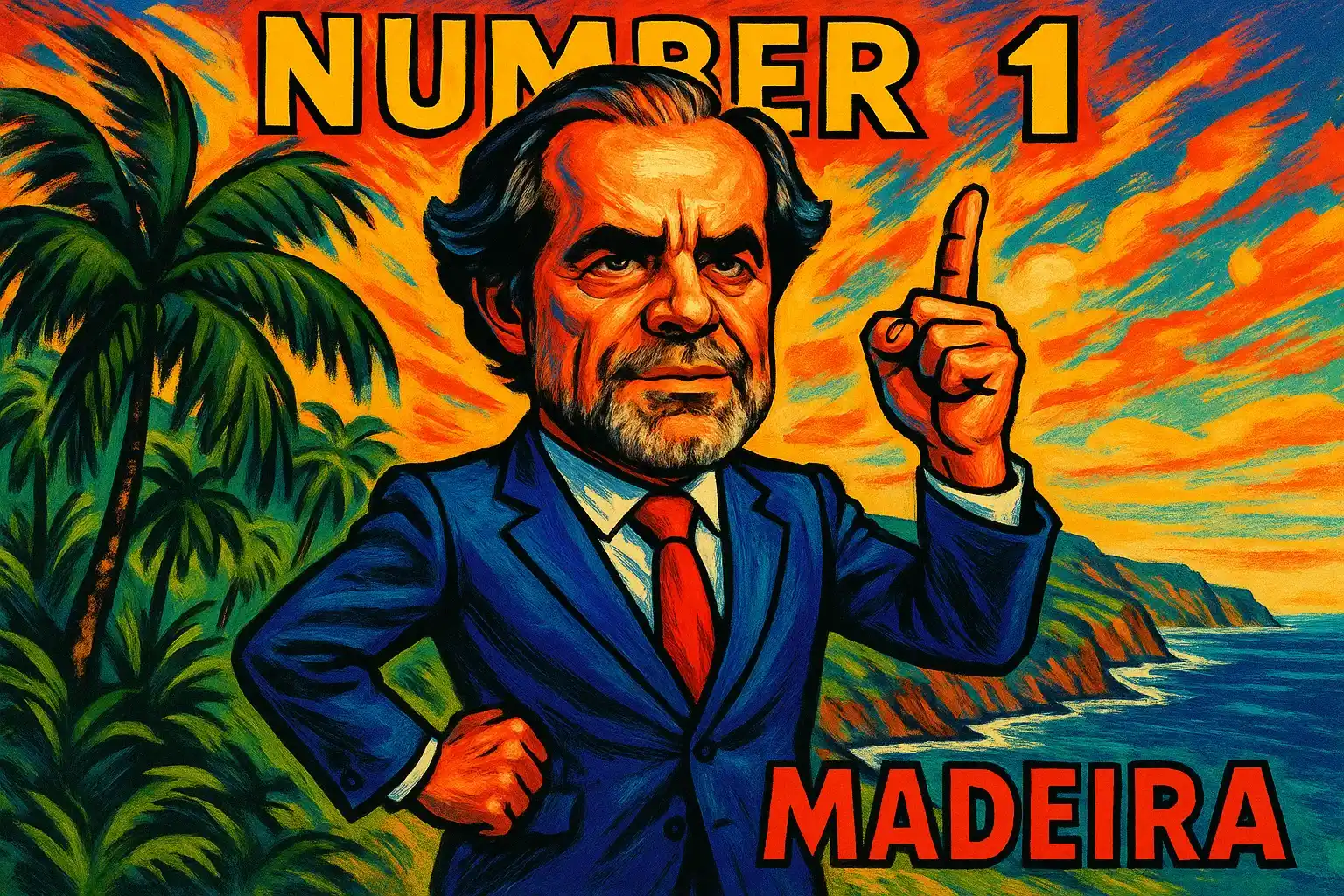
PSD Removes Term Limits for Party Leadership
At the latest regional congress of the Social Democratic Party (PSD) in Madeira, its leader Miguel Albuquerque delivered a message that went beyond electoral success. It was also about continuity, control, and the future of leadership. His central idea was simple: the party keeps winning, and it will continue to win.
This time, however, the message was not only rhetorical. It was reinforced by a concrete decision.
During the congress, PSD Madeira approved changes to its internal statutes. The most important change was the removal of term limits for the party leadership, allowing Albuquerque to remain leader beyond previous limits.
When Were The Limits Set?
The term limits were introduced in January 2015, shortly after Miguel Albuquerque took over the party leadership.
The Context: After Alberto João Jardim’s 37-year tenure, there was a strong internal and public demand for "cleaner" and more modern governance.
The Rule: The 2015 statutes capped the party leadership at twelve years (or approximately three terms).
The Intent: At the time, Albuquerque himself championed these limits to demonstrate that his leadership would be different from the "eternal" leadership of the past, ensuring that power would circulate more frequently.
But a lot has happened since 2015, and PSD Madeira’s leadership is now deeply affected by the ongoing investigations that emerged in 2024, with the regional president and the former mayor of Funchal designated as formal suspects in an investigation involving allegations of corruption and related offences.
For the people of Madeira - according to the PSD - this creates a stable government in terms of personnel, but it is a tainted one in terms of reputation. The region is essentially being led by a figure who is simultaneously running the government and being investigated by a dedicated elite team of the Judicial Police.
Albuquerque and his close ally Pedro Calado, the former mayor of Funchal who was integrated into the Regional Political Commission despite ongoing legal troubles, both face active investigations. Calado was detained in January 2024 and resigned from his mayoral post days later. He is suspected of corruption, breach of duty, undue receipt of advantage, abuse of power, and influence peddling. Albuquerque himself is an arguido (formal suspect) in a sprawling probe examining alleged corruption, prevarication, abuse of power, and crimes against the rule of law. He was not detained due to parliamentary immunity.
The Madeiran Argument: Winning Becomes Structure
PSD Madeira’s position now rests on connected elements:
A long record of electoral victories, presented as proof of strength, not as proof of a lack of democracy
A narrative of stability and competence, with the opposition described as weak and the Madeiran sovereign described as inherently wanting what he calls “stability“, meaning no change in power.
This shifts the meaning of continuity. It is no longer only the result of elections - it is also shaped by institutional decisions inside the party.
The Authoritarian Stance: Stability Through Rule Change
Rules are changed or adjusted in ways that remove limits on leadership duration.
This point is new and important in Madeira. The argument has moved from we win, so we stay to we win, and therefore the rules must allow us to stay longer - or: if voters continue to support the same leadership, there should be no internal barrier forcing change.
Repeated electoral victories are used to argue that leadership remains legitimate and should continue. Past victories are also used to delegitimize rules designed to protect democratic renewal - rules which typically allow for the rotation of power over time, a core principle in democratic systems.
When leaders argue that:
long-term success justifies long-term rule
perceived stability requires continuity
rules can be adjusted to support that continuity
These dynamics have historically been associated with more entrenched forms of political power. But these moves show clearly that power is no longer defended only through votes - it is also being secured through internal rules.
And that shift, even within a democratic system, is where the broader political story begins and democracy erodes.
It is up to the Madeiran people to claim their voice.



Comments