
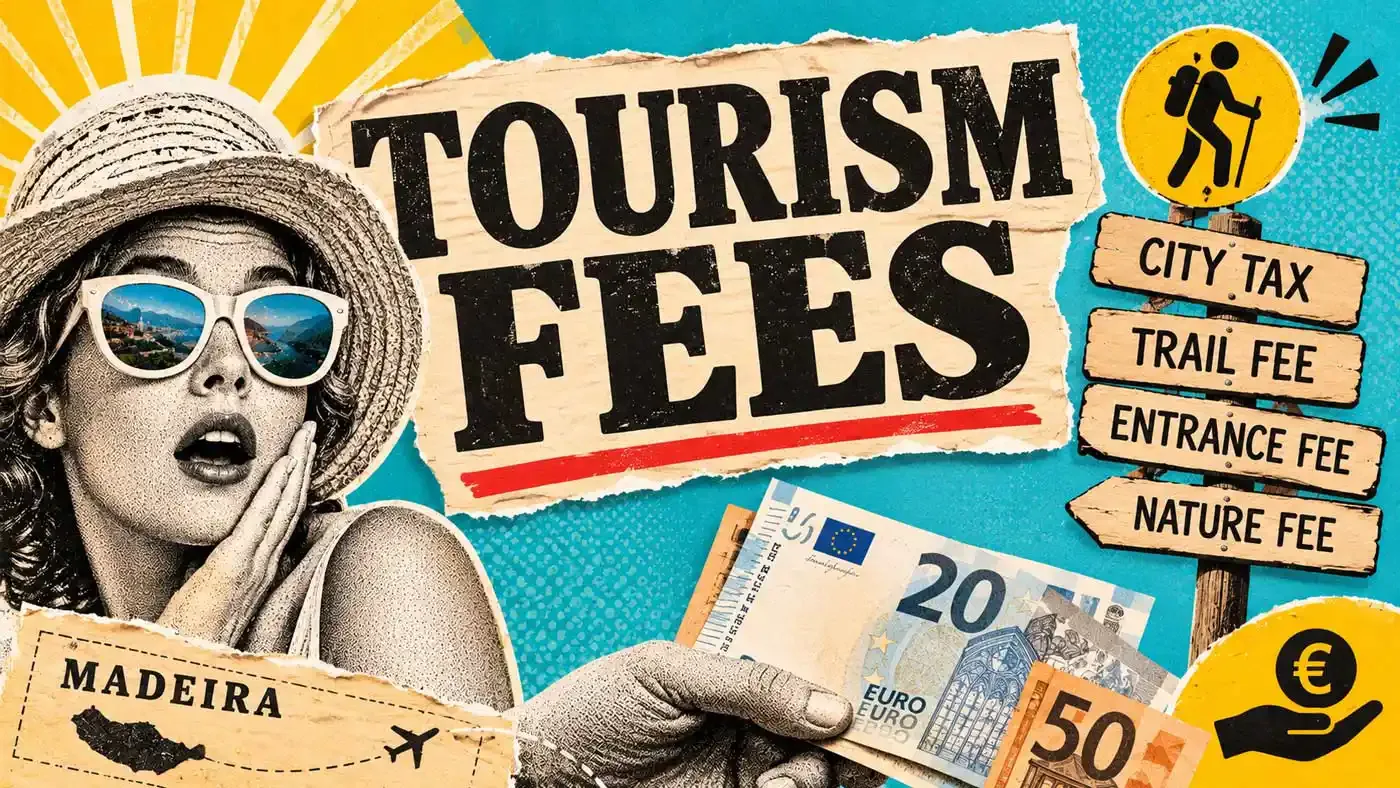
Tourism fees, such as fees for overnight stays, hiking trails or rental cars, are often presented as a straightforward way to make visitors contribute more to a region's economy. The argument is appealing:
charge tourists a little extra
generate additional revenue for the region
and, perhaps, discourage visitors who supposedly bring little economic benefit to the island.
The strongest argument for fees is that the money stays in Madeira, and that is largely true. Unlike profits that flow to hotel owners, booking platforms or tour operators based elsewhere, a locally collected fee keeps revenue in Madeira. If properly managed, it could fund infrastructure, environmental protection, trail maintenance, transport and local services that benefit residents. In principle, this creates a more circular local economy, where tourism revenue is reinvested in the destination that generates it.
But there is a fundamental problem with the reasoning that tourism fees create wealth in the region. Making a destination more expensive does not automatically make its economy stronger, nor does it attract wealthier visitors. The assumption that tourists with less money are somehow less valuable to Madeira also deserves considerably more scrutiny.
The Case for Tourism Fees
Supporters of the fees have a serious case, and it deserves a fair hearing. Funchal's tourist tax regulation says the charge is a counterpart for the urban works, cleaning and cultural services that visitor numbers put under pressure.
The regional government makes a similar argument for the trail fees. It introduced them in October 2024 as a charge for the waste-cleaning service on the classified trails. Miguel Albuquerque, the regional president, has defended the 2027 increases as a matter of users paying for what they use.
Hiking trails are a user-pays situation. You are using an infrastructure, and you are paying for using that infrastructure.
Miguel Albuquerque, President of Madeira's Regional Government
There is a gap between that principle and the paperwork, however. Funchal's regulation lists what the tax is for. But it contains no clause reserving the revenue for those purposes, so the money enters the general municipal budget.
Mayor Jorge Carvalho says the revenue should go to urban cleaning, water supply, roads and culture. That would benefit residents and visitors alike, he says. The business association ACIF-CCIM is still asking the regional government and the councils for a consolidated report on every fee. It wants to know how much each raises, who collects it and how it is spent.
| Fee | Amount | Revenue |
|---|---|---|
| Funchal overnight tax (ACIF estimate on 2025 volumes) | €2 a night | €14.33 million a year |
| Funchal overnight tax from 2027 (ACIF estimate, same volumes) | €4 a night | about €28.66 million a year |
Making Madeira More Expensive Doesn't Make It More Valuable
One argument frequently heard in favour of tourism fees is that they ensure visitors spend more money on the island. Those who cannot afford the additional costs might decide to go elsewhere, supposedly leaving room for wealthier tourists who contribute more to the economy.
But making a place artificially more expensive doesn't somehow make it more attractive to people with more money. Madeira remains the same destination, with the same attractions, infrastructure, restaurants and services. Besides Maintenance, nothing about the actual experience has improved simply because a visitor has been asked to pay an additional fee.
Similar Visitors, Less Purchasing Power to Spend
In practice, a fee of a few euros is unlikely to change who comes. Madeira may well attract largely the same visitors, with a little less money left to spend during their stay. A fee does not create additional economic value by itself. It changes where some of the visitor's money goes.
At best, the revenue funds public goods whose benefits outweigh the cost of collection and the risk of discouraging visitors. At worst, it transfers spending away from local businesses without improving residents' living standards. The net effect depends on the size of the fee, how visitors react and what the money is actually spent on.
And there is another question worth asking. A backpacker spends carefully, visits local establishments and explores the island independently. Why should they be considered less valuable than someone who flies business class and spends considerably more in total, but keeps most of that spending within a luxury hotel?
Corporate Players Cater To Wealthy Tourists, But What About The Local Economy?
The fee debate often assumes that fewer so-called 'low-quality visitors' and more high-spending ones would be good for the whole island. The low-quality label usually means young people, independent travellers and explorers who engage with local culture. Is it really a given that replacing them benefits the countless small businesses, entrepreneurs, restaurants and souvenir shops across the region?
Or would it primarily benefit the businesses that serve wealthy visitors, particularly the large hotel groups that specialise in the luxury market? The relevant question is which spending patterns create more local jobs, income and resilience, and how much of each euro stays in circulation on the island.
The Government Collects, But Who Actually Benefits?
This is perhaps the most important distinction in the entire debate. Tourism fees generate revenue for the public sector. They do not automatically increase the income of the people who work in tourism or the businesses that depend on visitors.
Consider a tourist who would otherwise spend €20 in a local restaurant but now has to pay an additional fee. That money goes to the public purse rather than to the restaurant owner, its employees or its suppliers.
Of course, public revenue can eventually finance infrastructure, public services and improvements that benefit the population. But this is not an automatic process, and collecting more money from tourists is not the same as ensuring that more money reaches local households.
The people who work in restaurants, hotels, transport, retail and countless other tourism-related businesses depend on visitors having money to spend. Every additional charge takes a little from the disposable budget available to them, even if the effect per visitor is small.
There is a fundamental difference between
a government collecting more revenue from tourism
and the people of Madeira becoming economically better off because of tourism.
The two should not be confused.

Why Independent Travellers Matter More Than Their Spending Suggests
There is also a tendency to underestimate the economic contribution of independent travellers, particularly backpackers and people travelling on smaller budgets. A backpacker might not spend €400 a night in a five-star hotel, but that does not mean they contribute nothing to the local economy. Quite the opposite can be true.
Independent travellers tend to interact more directly with the communities they visit. They eat in small restaurants, have drinks in neighbourhood bars, use local transport and visit independent shops. They book activities with smaller operators and discover places outside the established tourist circuit. Their spending might be smaller individually, but it can reach a much wider range of local businesses.
This matters because a healthy local economy is not built exclusively around a handful of large companies. It also depends on the small café that employs three people, the family-run restaurant, the independent taxi driver, the neighbourhood grocery shop. Countless small businesses like these keep communities economically active. These are precisely the businesses that benefit when money circulates through the local economy rather than remaining concentrated in a relatively small number of establishments.
Compare that with a wealthy visitor staying in a five-star hotel such as the Savoy. They eat in its restaurants, hire a private chauffeur to take them to the golf course and return to their hotel afterwards.
There is nothing inherently wrong with that kind of tourism. Luxury hotels and their employees are also part of Madeira's economy, and the money does not necessarily leave the island. Savoy Signature, for example, belongs to the Madeiran AFA group. But the fact that someone spends considerably more money does not necessarily mean that their spending generates proportionally greater benefits for the wider community.
A substantial part of that expenditure might remain within the hotel, its suppliers and a limited number of larger businesses. Meanwhile, the smaller establishments that depend on a broader distribution of visitors see comparatively little of it. Spending level and local reach are two different things.
The question, therefore, should not simply be how much money a tourist spends. It should be how widely that money circulates and how many people ultimately benefit from it.
Long-Term Consequences
There is another aspect that seems to receive surprisingly little attention: the long-term consequences of continually increasing the cost of visiting a destination. Visitors are not obliged to return to Madeira. They have countless alternative destinations, and their decisions are influenced by the overall value they receive for their money.
An additional fee might seem insignificant in isolation. But accommodation, restaurants, transport, activities, access charges and other expenses all contribute to the final cost of a holiday.
When visitors increasingly feel that they are being charged for every aspect of their experience, this can affect how they perceive a destination. They might shorten their stay, reduce their spending, choose alternative destinations next time or simply be less inclined to recommend Madeira to others.
None of this means that every visitor will change their plans because of a tourism fee. But it is worth considering whether the additional public revenue is worth the potential loss of goodwill, repeat visits and spending elsewhere in the local economy.
A destination's competitiveness is not determined by how much money it can extract from each visitor. It also depends on the experience people receive and whether they feel that returning is worthwhile.
Tourism Fees Are Not an Economic Development Strategy
Ultimately, the problem with tourism fees goes beyond the fees themselves. It concerns the economic model that Madeira is continuing to build around tourism.
The island has become increasingly dependent on an industry whose performance is influenced by factors largely beyond its control. These include
international economic conditions
geopolitical instability
airline & airport capacity
changing consumer behaviour and competition from other destinations.
The dependence showed in the pandemic. When visitors stopped coming in 2020, the region's GDP fell 15.4% in real terms, almost twice the national drop.
Rather than addressing this dependence, tourism fees risk reinforcing an idea. The solution to every economic challenge, it suggests, is to extract a little more money from the people who visit.
But what happens if tourism slows down significantly? What happens if international instability, an economic downturn or changing travel habits cause visitor numbers to fall? A region that has increasingly organised its economy around tourism, while failing to develop sufficient alternatives, will be particularly vulnerable. The money collected through tourism fees does not change this reality.
Madeira arguably needs an economy in which tourism contributes to prosperity without becoming the exclusive dominant force determining the region's future. That means creating opportunities in other sectors, supporting local businesses, developing higher-value activities and ensuring that economic growth translates into better living conditions for the population.
There is nothing wrong with asking visitors to contribute to the costs associated with tourism. But the debate should focus on what these fees actually achieve.
Suppose the government collects more money while local workers continue to struggle with low wages. Average monthly earnings in Madeira were €1,406.8 in 2024, about €170 below the national figure, and 55.4% of the region's taxpayers declared less than €13,500 a year. Small businesses face increasing costs and the economy becomes ever more dependent on tourism. Then who exactly is benefiting?
Taking a larger share of the money generated by tourism in Madeira, is not the same as making tourism work better for Madeirans . And making Madeira artificially more expensive is certainly not a substitute for developing a stronger economy.





Comments