
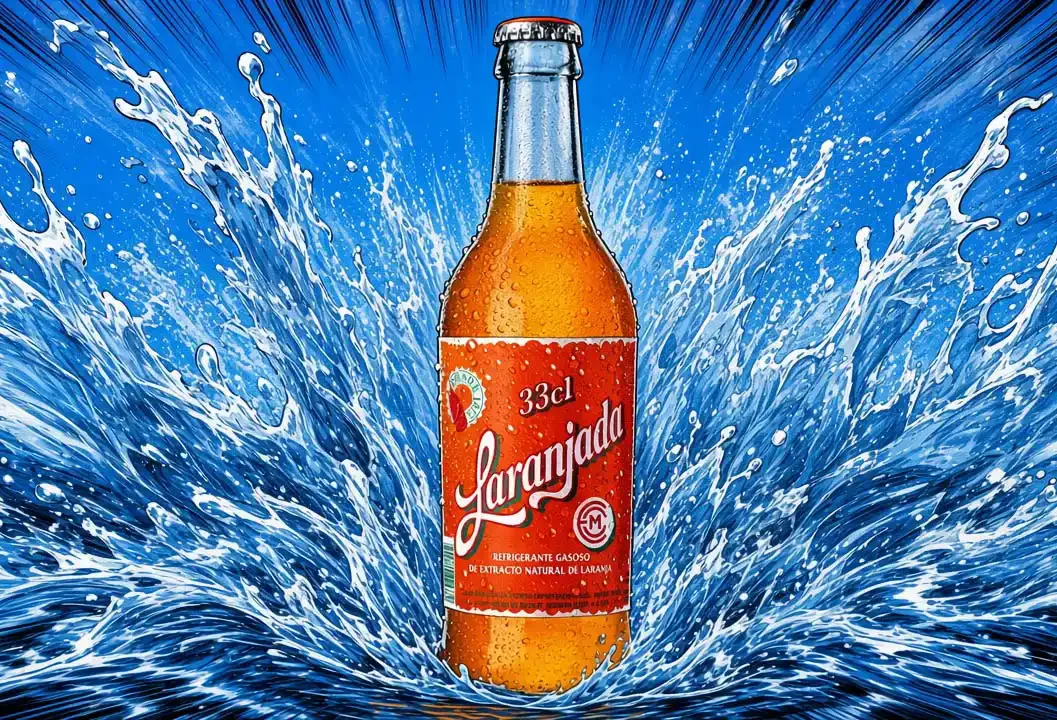
Ask for a Laranjada in any bar in Madeira and you get a piece of history. The bright orange soda first appeared in Funchal in 1872. That makes it older than Coca-Cola, which was first sold in the United States 14 years later. Laranjada is considered the first soft drink ever produced in Portugal.
A Welsh Boy Who Arrived in 1856 Founded Madeira's First Brewery
Laranjada was created when Portugal was still a kingdom, and the monarchy lasted almost four more decades, until 1910. The drink is credited to Henry Price Miles, who left Wales with his mother as a child and arrived in Madeira in 1856. From the age of 12, he worked as an apprentice for the wine merchant James Rutherford.
The year 1872 was a busy one for Miles. The Rutherfords left for London after phylloxera destroyed most of Madeira's vineyards, and Miles bought their wine company. In the same year, he founded the Atlantic Brewery (Cervejaria Atlântica) in Funchal. His wine business still exists today as the Miles Madeira wine brand.
It was the first factory in Portugal to make beer on an industrial scale. At the time, few Madeirans knew what beer was. To win them over, the Miles family gave away beer in the streets of Funchal. They carried the bottles in the baskets used for the grape harvest.
Coca-Cola Arrived 14 Years Later, at Five Cents a Glass
On the other side of the Atlantic, the pharmacist John Stith Pemberton created Coca-Cola in Atlanta. He made it as an alcohol-free drink after Atlanta passed prohibition laws in 1886.
The first glasses were sold at Jacob's Pharmacy in Atlanta on 8 May 1886. Each one cost five cents. By then, Madeira already had its own fizzy orange drink. Visit Madeira, the regional tourism board, calls Laranjada one of the oldest soft drinks in the world.
Portugal Kept Coca-Cola Out Until the First Bottle in 1977
In Portugal, the American drink had a much harder start. In 1927, the poet Fernando Pessoa was a copywriter at Hora, at the time the only advertising agency in the country. He was hired to write a slogan for the drink's launch.
"First you find it strange, then it gets under your skin."
Fernando Pessoa, poet, in his 1927 slogan for Coca-Cola
The slogan worried Ricardo Jorge, the country's director of health. He saw the drink as a kind of drug, and the launch was stopped. Under the Estado Novo dictatorship of António de Oliveira Salazar, Coca-Cola stayed out of the country. According to the Portuguese newspaper Observador, Salazar said the drink was habit-forming. The first bottle was sold in Portugal only in 1977.
By then, Laranjada had been on sale in Madeira for 105 years. You can read more about the regime in our guide to Salazar's Estado Novo.
Two Rival Factories Merged Into One Brewery in 1934
In 1922, the Araújo and Tavares families opened a second factory in Funchal, the Fábrica Leão. It made a Pilsner beer and the famous orange soda Laranjada. Then came hard times. A local bank, the Banco Henrique Vieira da Silva, collapsed, and a deep recession followed in the late 1920s and early 1930s.
Both factories decided that Madeira was too small for two breweries. In 1934 they merged into the Empresa de Cervejas da Madeira, known as ECM.
| Partner | Share |
|---|---|
| Sociedade de Água do Porto Santo (Fábrica Leão side) | 47% |
| H.P. Miles & Companhia (Miles family) | 47% |
| Leacock & Companhia | 6% |
Nationalised in August 1975, Then a Coca-Cola Licence for 26 Years
After the Carnation Revolution of 1974, the state took control of the beer industry. On 30 August 1975, it nationalised the big mainland brewers, such as CUFP and the Sociedade Central de Cervejas. A decree of the same day nationalised the Portuguese-owned shares in ECM.
The shares held by the foreign partners, the Miles and Leacock companies, stayed untouched. In a statement of 9 September 1975, the workers said they had voted massively against the nationalisation. On the mainland, the state later merged the nationalised brewers into two groups, Centralcer and Unicer, today's Super Bock Group.
Two years later came a twist. From 1977 to 2003, ECM had the right to bottle and sell Coca-Cola in Madeira. According to the history of ECM on Portuguese Wikipedia, Coca-Cola sold less than the brewery's own brands. In Madeira, Laranjada still has a bigger market share than Coca-Cola, it says.
Pestana Group Took Full Control of the Brewery in 2004
The hotel company Pestana Group entered ECM in 1994, when it bought 51% of H.P. Miles. By 1996, the brewery had opened a new factory at the Socorridos industrial park. The site covers 36,000 square metres and has six bottling lines. At the time, it was the largest industrial investment ever made in the archipelago.
Pestana gained a 68% controlling stake in 1999 and bought out the Miles family's last shares in 2004. In 2022, the PSD group in the regional parliament proposed a vote of congratulation for the 150th anniversary of brewing in Madeira. At the time, ECM had about 250 employees and served around 3,500 customers. It reached every point of sale in the region.
| Year | What happened |
|---|---|
| 1856 | Henry Price Miles arrives in Madeira from Wales as a child |
| 1872 | Miles founds the Atlantic Brewery in Funchal; Laranjada is born |
| 1886 | Coca-Cola is first sold in Atlanta, United States |
| 1922 | Fábrica Leão opens in Funchal and makes Laranjada |
| 1927 | Fernando Pessoa writes a Coca-Cola slogan for the Hora agency; the launch in Portugal is stopped |
| 1934 | The two Funchal factories merge into ECM |
| 1970 | ECM creates Brisa Maracujá |
| 1975 | The Portuguese-owned shares in ECM are nationalised |
| 1977 | The first Coca-Cola is sold in Portugal; ECM starts bottling it in Madeira |
| 2004 | Pestana Group owns all of ECM |
Mixed With Wine or Coral, and One Gold Medal for Laranjada
Laranjada is strongly carbonated, clear and slightly sour. It has a bright orange colour and a strong taste of orange peel. The drink has always belonged to the island's festivals. There is no traditional party without a "Laranjada cocktail", a mix of the soda with wine or Coral beer.
At an arraial, a village street festival, someone is almost always drinking wine with Laranjada next to their espetada, according to Visit Madeira. The soda softens the alcohol in the wine.
ECM's drinks have won more than a hundred Monde Selection medals, including one gold for Laranjada. Monde Selection awards are not a competition, though: only products that pay to enter are judged.
Laranjada also has a famous younger sibling. Created in 1970, Brisa Maracujá was the world's first soft drink made with pure passion fruit juice.
Source: pt.wikipedia.org
Source: pt.wikipedia.org
Source: en.wikipedia.org
Source: en.wikipedia.org
Source: milesmadeira.com
Source: marketeer.sapo.pt
Source: en.wikipedia.org
Source: observador.pt
Source: visitmadeira.com
Source: visitmadeira.com
Source: dnoticias.pt


Comments