
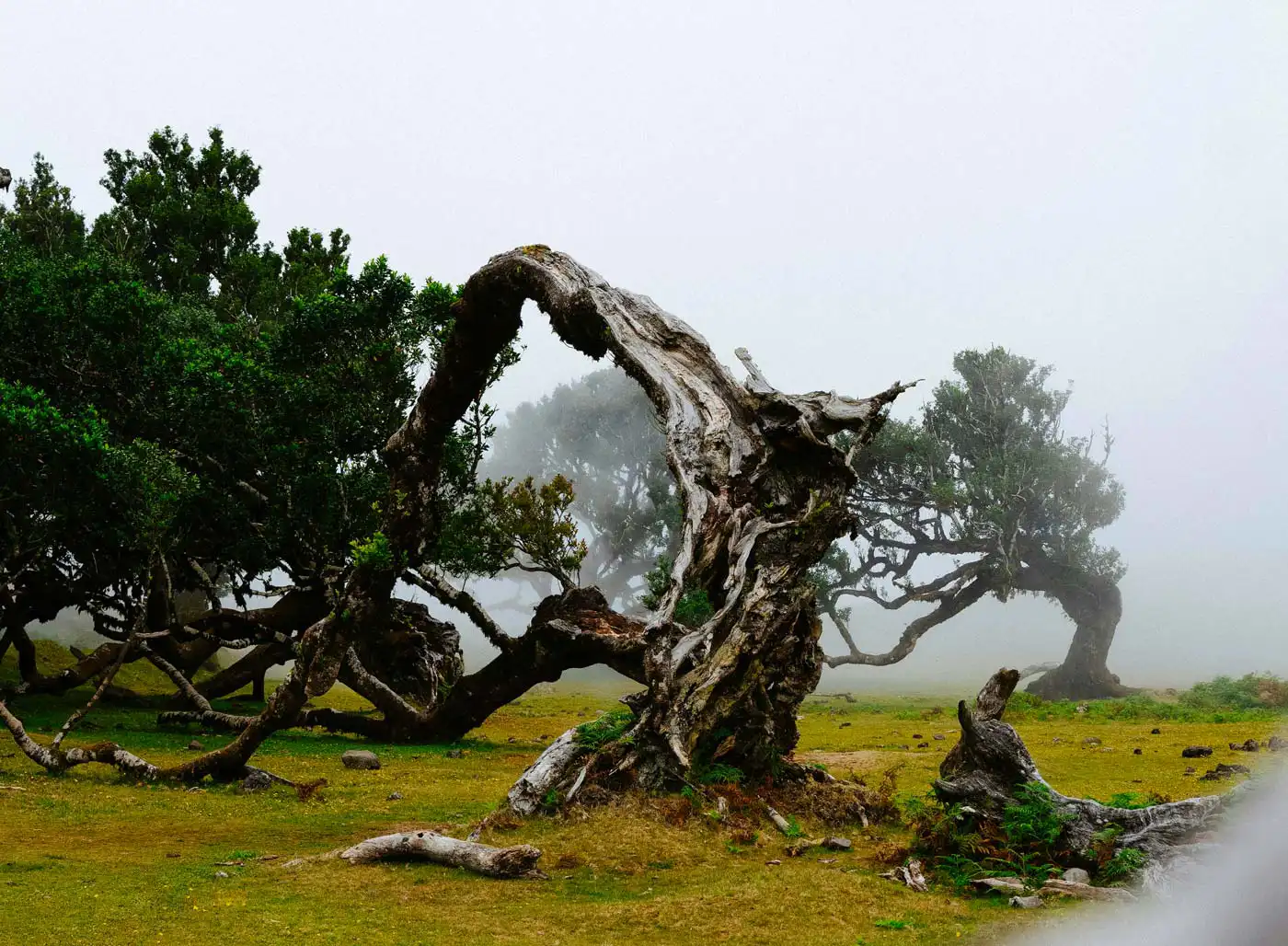
A post on social media is asking why Fanal is in a state of degradation. Hikers pay trail fees that are meant to protect such natural heritage. The author, Enia Gouveia, questions how the trail fee revenue is used and how the area is managed and preserved. Diário de Notícias reported on the post on Thursday.
The post puts two issues at its centre. One is where the money from the fees charged on Madeira's hiking trails ends up. The other is the condition of the natural heritage at Fanal.
Post Published on 23 November Questions Fee Spending at Fanal
Gouveia published the text three days before the newspaper's report, which puts it at 23 November. It warns of growing tourist pressure on the centuries-old til trees of Fanal. The author asks whether the fee revenue is really being applied to the maintenance, conservation and management of the natural spaces.
If the fees charged on the hiking trails are meant to contribute to the maintenance, conservation and management of the natural spaces, how can the state of degradation we find at Fanal be justified?
Enia Gouveia, author of the post
The post also makes a wider point about how the island treats its landscape. Gouveia writes that Fanal, like Madeira as a whole, "is not an amusement park". It is natural heritage that must be valued and preserved, the post says. The author criticises the lack of protection in the face of growing tourist pressure.
Fanal Lies Inside Laurisilva Listed by UNESCO in 1999
Fanal is part of Madeira's laurisilva, the laurel forest that UNESCO classifies as a Natural World Heritage site. The post refers to that status to stress the importance of the area. The newspaper describes the forest as a UNESCO Natural World Heritage site in its report.
The listing dates from 1999, according to the English Wikipedia entry on the Madeira evergreen forests. It covers about 150 square kilometres of forest. Wikipedia describes about 90 percent of it as primordial forest.
Til Trees May Be Older Than Settlement That Began After 1420
The trees at the heart of the post are the til trees of Fanal. The newspaper describes them as centuries old. Some of them, the author says, may have existed since before the settlement of Madeira began.
That would make them over 600 years old. Madeira was claimed by Portuguese sailors in 1419 and settled after 1420, according to Wikipedia. The post does not give an age for any individual tree.
Hundreds of Views Bring Call for Guided-Only Visits and Assembly Petition
The post has drawn hundreds of views and comments, the newspaper reports. Among the comments is a proposal from Maria João Pires Correia. It calls for a manifesto and a collection of signatures to restrict visits to Fanal.
Under the proposal, visits would need the company of guides accredited by the supervising authority. The commenter compares the idea to authorised study visits.
The same commenter also calls for new til trees to be planted to replace the degraded specimens. The comment says a petition should be taken to the Legislative Assembly of Madeira so that the regional parliament discusses the question. The newspaper does not report any response from the regional government or the Institute of Forests and Nature Conservation, known as IFCN.
Regional Institute Announced a 3,000-Visitor Daily Cap in November 2025
The degradation of Fanal is not a new concern. In November 2025, IFCN announced a limit of 3,000 visitors a day for the area, as Times of Madeira reported at the time. The limit was based on a capacity study with the University of Madeira. The plan also included a laurisilva interpretation centre and new signage.
Earlier that month, IFCN began fencing off clusters of the oldest trees. The institute said it would install more than 1,200 metres of barriers by the end of 2025. Nature guards were on site every day, and the Forestry Police carried out regular patrols.

Trail Fee Rises From €4.50 to €7.50 in April 2027
Madeira introduced a €3 fee for non-resident hikers on seven trails in October 2024. From 1 January 2025 it applied to all 38 recommended trails. The fee brought in €351,000 in its first three months, according to figures reported in April 2025.
The regional government has since raised the general fee to €4.50 and will raise it again to €7.50 from 1 April 2027. A new Fanal circuit, including the PR13 Vereda do Fanal, is to cost €18 once the route opens next year. Residents of Madeira and children up to 12 do not pay.
| Measure | Figure |
|---|---|
| Trail fee introduced on seven trails, October 2024 | €3 per hiker |
| Fee extended to all 38 recommended trails | 1 January 2025 |
| Fee revenue, October to December 2024 | €351,000 |
| General non-resident fee in 2026 | €4.50 |
| General non-resident fee from 1 April 2027 | €7.50 ▲ +66.7% |
| Fanal circuit (PR13) once the route opens in 2027 | €18 |
| Daily visitor cap for Fanal, announced November 2025 | 3,000 visitors |
| Fencing around Fanal's old trees, announced November 2025 | 1,200 metres |
Officials have said the fees fund the maintenance and conservation of the trails and natural heritage. The post by Gouveia asks for proof of that at Fanal. The newspaper's report gives no figures on how the revenue has been spent there.
Have you been to Fanal recently, and what condition did you find the trees and the ground in?
Source: dnoticias.pt





Comments