
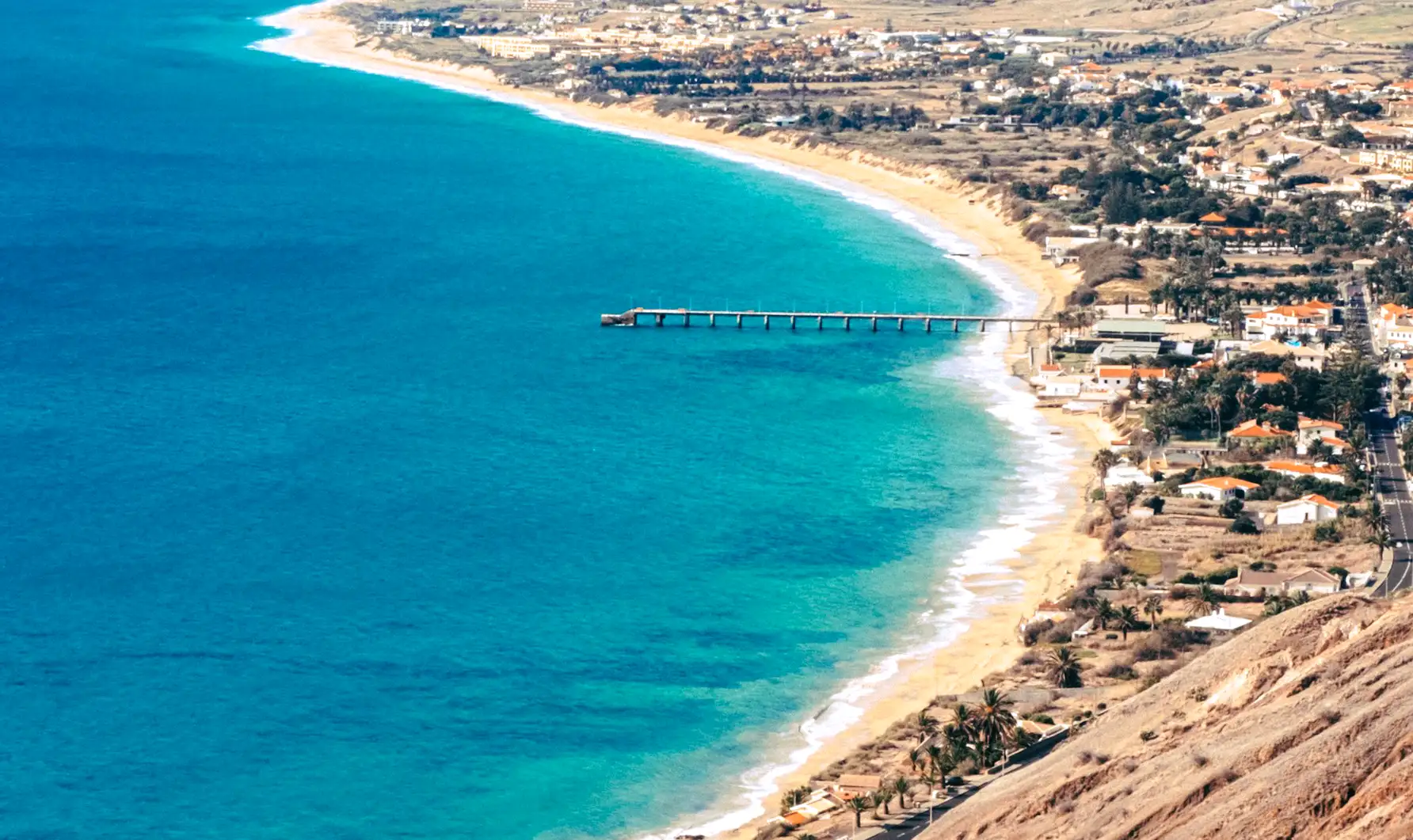
Porto Santo switched off its diesel generators on Friday and ran entirely on wind, solar and battery power for the first time. Officials said the arrangement can now repeat for more than 200 days a year, moving the small Madeira island closer to full energy independence. The milestone followed the inauguration of new renewable equipment worth €34 million. Miguel Albuquerque, president of the Regional Government, and Maria da Graça Carvalho, Portugal's Minister of the Environment and Energy, attended the ceremony on the island.
Carvalho's visit began at the Central Térmica at 15:00. It continued to the island's desalination plant at 16:00, then to Vila Baleira at 17:30, together with Albuquerque and Porto Santo's mayor. Albuquerque used the stop to frame the investment as part of a broader regional strategy. The strategy, he said, goes back more than a decade.
For 11 years we have defended the importance of strategic autonomy, which has become even more relevant in the current international context of uncertainty. We are talking about food autonomy, connectivity, both digital and physical, and above all, energy autonomy.
Miguel Albuquerque, president of the Regional Government
A €34 Million Investment Funds Wind, Solar and Batteries
The €34 million investment combines new wind turbines, an expanded solar park and a large battery storage system. Together, they let Porto Santo cover all of its electricity demand from renewable sources during periods of strong sun and wind. The island's thermal power plant will stay in reserve and switch back on whenever renewable output drops. Francisco Taboada, president of the Empresa de Electricidade da Madeira (EEM), confirmed the investment figure at the ceremony.
This is a very important step we are taking today to guarantee strategic autonomy in energy for the Autonomous Region of Madeira.
Miguel Albuquerque, president of the Regional Government
Two New Turbines Add 7.6 Megawatts of Wind Power
A new wind farm adds two turbines of 3.8 megawatts each, for a combined 7.6 megawatts of installed capacity. The turbines join equipment already on the island and are built to take advantage of Porto Santo's steady trade winds.
A New 4-Megawatt Solar Park Joins the Existing 2 Megawatts
A new photovoltaic park adds 4 megawatts of solar capacity on top of the 2 megawatts already installed on the island. Combined, the island's solar installations now total about 6 megawatts. The added panels give Porto Santo a second renewable source to balance supply through the day, alongside the wind farm and battery storage.
Batteries Can Store 20 Megawatt-Hours for Backup Power
A new battery system can store 20 megawatt-hours of electricity. It smooths the gap between when the wind blows or the sun shines and when residents actually use power. Carvalho said the storage capacity is central to extending the hours Porto Santo can run on clean energy alone.
The goal is to operate as much of the time as possible at 100% on renewable energy.
Maria da Graça Carvalho, Minister of the Environment and Energy
Carvalho said the investment is about more than how electricity is produced. It is also a move toward self-sufficiency and energy sovereignty. She said it brings benefits for the environment, air quality and the fight against climate change.
One of the main advantages, she said, is less dependence on fossil fuels. Deliveries to Porto Santo travel by sea, exposed to storms and shipping delays.
Porto Santo's Renewable Capacity Reaches Nearly 14 Megawatts
Combining the new wind, solar and battery equipment with existing capacity, Porto Santo now has close to 14 megawatts of renewable power installed. Carvalho called Porto Santo the first island among Europe's outermost regions to reach this level. She said Madeira is well ahead of the Azores, the Canary Islands and France's island territories in the energy transition.
The stakes go beyond electricity generation. Porto Santo's desalination plant, which supplies the island's drinking water, depends heavily on electricity to run. Carvalho said that makes energy sovereignty on the island inseparable from water security.
Albuquerque used the occasion to praise the EEM's staff and its president, Taboada, for delivering the project.
It is not just any company. It is a company that makes us proud, for the work it has done and for its capacity for innovation, modernization and transformation. It is an example of efficiency and the ability to deliver.
Miguel Albuquerque, president of the Regional Government
Albuquerque also pointed to the Serra de Água Hydroelectric Plant, on Madeira's main island, as an earlier example of the same approach. He said it was the first project funded by Portugal's Recovery and Resilience Plan (PRR) to move forward nationally.
When other projects were still at an early stage, this intervention was already under way.
Miguel Albuquerque, president of the Regional Government
Electricity Price Rose Just 1% in Six Years, EEM Says
Despite the new equipment, Porto Santo residents will not see a lower electricity bill. Taboada, the EEM president, said prices are not set island by island. They are regulated nationally by ERSE, Portugal's energy regulator, which calculates system-wide costs and sets tariffs every year.
Porto Santo cannot be the one to lower the price of energy, because if a wind farm appears in the Algarve tomorrow, electricity is not reduced only in the Algarve either.
Francisco Taboada, president of the EEM
Taboada said the same national system that keeps local renewable savings from reaching individual bills also shields consumers from sudden price spikes elsewhere.
When there is a crisis, we do not feel the impact the next day or even the next month.
Francisco Taboada, president of the EEM
Over the past six years, Taboada said, the price of electricity in Madeira rose only about 1%. Other consumer goods, he said, rose between 10% and 15%. He called that, in effect, a reduction in the real price of electricity. Carvalho cited a similar figure for this year alone: an increase of about 1%. That is well below the roughly 15% rise she linked to purely thermal production.
Source: dnoticias.pt Source: dnoticias.pt Source: dnoticias.pt Source: dnoticias.pt Source: dnoticias.pt



Comments